A digital space for the latest breakthroughs, news, and discussions in Psychoeuphorology.
Tuesday, July 22, 2014
We Do Live in a Golden Age (with Colorful Filling)...
Is Rock and Roll still relevant and viable?
Usually this question is only asked as a jump off to ramble on the decay of American pop culture. It's become the 'back in my day...' speech for younger Baby Boomers and older Gen X'ers.
Talking points include:
-Nostalgic references to bands that were never actually relevant or viable (e.g. The Velvet Underground. That's right Lou Reed, here's the eulogy you always wanted, you overrated poser. I know you'll rest in peace. The grave is a great place to have no real ideas).
-Insinuations that Ariana Grande is responsible for growing belligerence in the Pacific Rim. Yes, we'd all have one less problem without Kim Jong Un, but let's not connect dots that aren't there.
-Vague explanations as to how The Twitter has undermined the character of American youth, aka 'the kids today...' sub-speech.
But getting back to the original question, is Rock and Roll a 21st Century music form?
Yes! The problem is not the music, but the musicians. Since the early 2000's rock has been in a talent drought.
Don't worry, these things happen. Rock and Roll itself emerged partly due to stagnation. By the mid-1950's, two major wars had either killed or derailed the young talent which fed traditional pop. Rather than developing fresh new acts, the music establishment was running on the fumes of Bing Crosby, Cole Porter, and whichever big bands could still scrounge bus fare to Des Moines. The time ripe for hungry young men with a raw, homespun sound.
For whatever reason -and I still haven't heard a good one- we just don't have great rock bands right now. There are several good ones, but none that add up to more than the sum of their influences. For example, Mastodon is very good metal band, but what do they do that wasn't being done 25 years ago? Joe Bonamassa is one of the strongest guitarists of his generation, but as long as his best material is classic rock covers, he won't make the transcendent impact of players like Clapton, Hendrix, et al. Rock doesn't lack a future so much as a way forward.
This brings up the next question: If America's best creative minds aren't making good rock music, what are they up to?
That answer: They're making cookies.
Today was the first time I realized how many more types of Oreos we have today as opposed to ten or even five years ago. Once upon a time, Halloween Oreos were a big deal. Today at the grocery story, I saw seasonal Limeade Oreos.
Limeade isn't even listed on the Oreo website. But Lemon is. So is Berry, Chocolate, Chocolate with Vanilla Cookies, Peanut Butter, Marshmallow Crispy, and... COOKIE DOUGH!
At the end of the day, there's no crisis at all. Rock music lacks creative vision right now, but the difference has been made up in the Nabisco labs.
Thursday, July 17, 2014
Remembering Tom Watson... The 2009 Open Championship; 5 Years Later
Five years ago, a 59 year-old Tom Watson nearly won a 6th Open Championship. Needing a par on the 72nd hole for the win, he bogeyed. One four-hole playoff later, Stewart Cink was the 2009 Champion Golfer of the Year.
I was crushed.
Tom Watson is one of the 15 greatest players of all time. He made his bones as Jack Nicklaus' greatest post-Kennedy Administration rival. He dominated the Open like no one since Harry Vardon.
Stewart Cink is a talented player and a worthy major champion. In 14 years between turning pro and winning the Open, he defined Very Good. He won 6 PGA Tour events and recorded a Top-5 finish in every major.
He also built a strong candidacy for World's Least Interesting Man.
Cink is the sort of boring, clean-cut southerner who has long filled out the PGA Tour's middle and lower classes. His is the consistent, conservative, uninspired game that golf instructors love.
I wasn't upset that Tom Watson lost. I just would have preferred he lose to another great player, an out-of-nowhere journeyman, Angel Cabrera, or any other opponent who makes for an interesting narrative. The disappointment came watching the tournament be won by someone so uncompelling.
The same year as Watson's Last Stand saw the publication of Mark Frost's The Match. It recounts a 1956 four-ball match in which up-and-coming amateurs Harvie Ward and Ken Venturi took on the aging professional team of Byron Nelson and Ben Hogan as part of a bet arranged at of Bing Crosby's infamous Clambakes. Though only a friendly game, Frost portrays it as a bellwether event in golf history.
The match was close throughout, but the cagey old pros won in the end. As Frost points out, never again would the gap between the best amateurs and professionals be so close. Golf at its highest level was no longer a game of leisure.
At the time, I thought the 2009 Open was a similar end of an era. With Tiger Woods declining fast, the future of professional golf was murky. Phil Mickelson, Ernie Els, and Vijay Singh -golf's last great shotmakers- were aging fast. In a decade on Tour, Sergio Garcia had gone from golf's most exciting talent to a player defined by failure. Despite the buzz around some kid named McIlroy, I assumed he would follow suit.
Turnberry seemed to be a Culloden moment (Smugly dropping references to Olde Scotland is as time honored a tradition as the Open itself). The bland, consistent, Scottsdale Standard game had won out over the expressive brilliance of Tom Watson. It seemed nothing interesting could fill Tiger's monolithic void.
Five years later, I'm pleased to say I was wrong. Els and Mickelson have captured the past two Open Championships. McIlroy followed a meltdown at the 2011 Masters by shooting the lowest aggregate score in U.S. Open history two months later. Bubba Watson has developed into the player John Daly once could have been. Even Martin Kaymer has reimagined the TPC style of play with his own Teutonic twist.
Hindsight reveals that the 2009 Open was no historic inflection point. Rather, it was the crowning achievement of a deserving professional, and one more story to tell the Watson grandchildren. Following golf is no longer as easy as watching Tiger kick everyone's ass, but that's not a bad thing.
I was crushed.
Tom Watson is one of the 15 greatest players of all time. He made his bones as Jack Nicklaus' greatest post-Kennedy Administration rival. He dominated the Open like no one since Harry Vardon.
Stewart Cink is a talented player and a worthy major champion. In 14 years between turning pro and winning the Open, he defined Very Good. He won 6 PGA Tour events and recorded a Top-5 finish in every major.
He also built a strong candidacy for World's Least Interesting Man.
Cink is the sort of boring, clean-cut southerner who has long filled out the PGA Tour's middle and lower classes. His is the consistent, conservative, uninspired game that golf instructors love.
I wasn't upset that Tom Watson lost. I just would have preferred he lose to another great player, an out-of-nowhere journeyman, Angel Cabrera, or any other opponent who makes for an interesting narrative. The disappointment came watching the tournament be won by someone so uncompelling.
The same year as Watson's Last Stand saw the publication of Mark Frost's The Match. It recounts a 1956 four-ball match in which up-and-coming amateurs Harvie Ward and Ken Venturi took on the aging professional team of Byron Nelson and Ben Hogan as part of a bet arranged at of Bing Crosby's infamous Clambakes. Though only a friendly game, Frost portrays it as a bellwether event in golf history.
The match was close throughout, but the cagey old pros won in the end. As Frost points out, never again would the gap between the best amateurs and professionals be so close. Golf at its highest level was no longer a game of leisure.
At the time, I thought the 2009 Open was a similar end of an era. With Tiger Woods declining fast, the future of professional golf was murky. Phil Mickelson, Ernie Els, and Vijay Singh -golf's last great shotmakers- were aging fast. In a decade on Tour, Sergio Garcia had gone from golf's most exciting talent to a player defined by failure. Despite the buzz around some kid named McIlroy, I assumed he would follow suit.
Turnberry seemed to be a Culloden moment (Smugly dropping references to Olde Scotland is as time honored a tradition as the Open itself). The bland, consistent, Scottsdale Standard game had won out over the expressive brilliance of Tom Watson. It seemed nothing interesting could fill Tiger's monolithic void.
Five years later, I'm pleased to say I was wrong. Els and Mickelson have captured the past two Open Championships. McIlroy followed a meltdown at the 2011 Masters by shooting the lowest aggregate score in U.S. Open history two months later. Bubba Watson has developed into the player John Daly once could have been. Even Martin Kaymer has reimagined the TPC style of play with his own Teutonic twist.
Hindsight reveals that the 2009 Open was no historic inflection point. Rather, it was the crowning achievement of a deserving professional, and one more story to tell the Watson grandchildren. Following golf is no longer as easy as watching Tiger kick everyone's ass, but that's not a bad thing.
Thursday, July 10, 2014
Picking Up the Crumbs of Crumbs
The Wall Street Journal today reported there may be investors interested in resurrecting Crumbs, a chain of cupcake bakeries which ceased retail operations earlier this week.
This makes sense. At this point Crumbs is a good value on paper. One could reason the company's biggest problem was over-expansion. Founded as a single location in 2003, within a decade it had grown to a chain of 79 stores. By 2011, is was listed on the NASDAQ. The cash intensive nature of expansion, coupled with the decline of the cupcake industry are what initiated the financial death spiral.
However, Crumbs had a more fundamental problem. Their cupcakes were lousy.
By volume, a Crumbs cupcake was about half frosting. This made for an unwieldy cupcake that defeated the point of the medium. On top of that, the frosting had no flavor. Though visually exotic, Crumbs cupcakes all featured this same insipid, sickly sweet frosting piled on a dry, flavorless cupcake. Factor in the $3-4 price for a single cupcake, and it's no wonder the novelty faded.
Crumbs may still become a useful investment. For the right price, it makes sense to buy the company and strip it to the bone. However, Crumbs is worthless as a bakery.
Friday, June 20, 2014
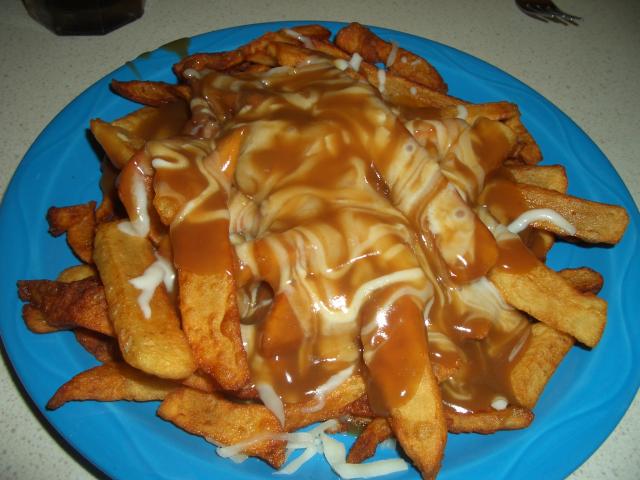
Poutine vs. Disco Fries: Everyone's a Winner With This Late Night Recipe
Though debate rages about the intricate aspects of each, they share the same three components: french fries, gravy, and cheese.
In Quebec, this means fries topped with a thin beef gravy and cheese curds. Though no one is certain of the word's origin, 'poutine' seems to derive from regional French colloquialisms which have different particular meanings, but generally translate as 'a disgusting mess on plate.'
Every time I talk to a real French person about poutine, they respond with the same sneering horror. Hence, I favor this etymology over less visceral theories.
Disco fries tend to use a thicker (often instant) gravy and melted cheddar or mozzarella. The best I know, its name derives from its popularity in the 1970's after a long night of booze, Bee-Gees, and blow.
In the spirit of international harmony, I've created this quick and easy recipe which combines the best aspects of both. In lieu of a better name, I call the NAFTA fries.
-1 bag frozen french fries, traditional or waffle cut.
-1 jar of quality beef gravy (Get the good kind. Go on, treat yourself! Or use homemade if you have that)
-1 tsp dried tarragon
-1 tsp fresh ground black pepper
-2 cups shredded sharp cheddar
1) Preheat the oven to 425 degrees. Bake the fries until deep brown, but not burnt. Plate the fries.
2) Bring the gravy to a simmer. Add the tarragon and black pepper, and stir.
3) Cover the fries with the cheddar.
4) Pour the gravy over the fries and cheddar. If desired, finish with a pinch of fleur de sel and a grind of black pepper over the top.
This recipe combines the superior melt of American cheddar, with the richer flavor of the Canadian gravy. It is best served with a season of House on Netflix at 2 AM.
Thursday, June 19, 2014
Ideas for Renaming the Washington Redskins That Acutally Work
With the U.S Patent and Trademark office revoking the Washington professional football team's trademark on the name 'Redskins,' there has never been a better time for owner Daniel Snyder to reconsider his choice of nickname.
Right now nothing is imminent. For one thing, a public browbeating from politicians, writers, and celebrities crying crocodile tears on behalf of the Native Americans is a bad way to convince a proud billionaire who holds all the leverage. Furthermore, it ignores the ramifications or renaming. If not, Redskins; then what?
The last thing Snyder wants is to undermine the brand equity of his eighty-year old franchise. He knows that the Redskins are more than a name. The Redskins are Sammy Baugh, George Allen, the Hogs, and three Super Bowl victories.
More than that, the Redskins are a passionate, loyal fan base. Much like the Bears and Packers, Washington and its fans value their identity as one of the league's most historic teams.
A new name has to evoke gravitas and local pride. Keeping the burgundy and gold is a must.
In the worst case, a name change brings in an aesthetic fitting an expansion team in a tertiary market. The team's name and on-field look would have no connection to the area. The team would seem like a fly-by-night arena outfit. Washington would be stuck with the second coming of the Jacksonville Jaguars.
It can't be some cheap, trendy, focus-grouped nonsense. It can't be a collective singular. As good as they are on the court, the Miami Heat and Oklahoma City Thunder sound like girls' soccer teams.
Here are a few ideas.
The Senators: It invokes the memory of Washington's former Major League Baseball team. The connection to the federal government makes good local sense. It's a good, though unoriginal fit.
The Gravers: This is a nod to the Bureau of Engraving and Printing, which operated one of the few major manufacturing facilities in the City of Washington at the time of the team's founding. The name is historic and locally appropriate. It fits in with other old-guard franchises such as the Packers and Steelers, who drew their original teams from the local workforce.
Check out this picture of the plant, circa 1918. A rare example of industrial elegance.
The Potomacs: What better way to represent all of Washington than to name the team after the river? Like 'Gravers,' it sounds like it could have been the team's name from the beginning. This is my favorite because it represents the city in the past, present, and future.
Right now nothing is imminent. For one thing, a public browbeating from politicians, writers, and celebrities crying crocodile tears on behalf of the Native Americans is a bad way to convince a proud billionaire who holds all the leverage. Furthermore, it ignores the ramifications or renaming. If not, Redskins; then what?
The last thing Snyder wants is to undermine the brand equity of his eighty-year old franchise. He knows that the Redskins are more than a name. The Redskins are Sammy Baugh, George Allen, the Hogs, and three Super Bowl victories.
More than that, the Redskins are a passionate, loyal fan base. Much like the Bears and Packers, Washington and its fans value their identity as one of the league's most historic teams.
A new name has to evoke gravitas and local pride. Keeping the burgundy and gold is a must.
In the worst case, a name change brings in an aesthetic fitting an expansion team in a tertiary market. The team's name and on-field look would have no connection to the area. The team would seem like a fly-by-night arena outfit. Washington would be stuck with the second coming of the Jacksonville Jaguars.
It can't be some cheap, trendy, focus-grouped nonsense. It can't be a collective singular. As good as they are on the court, the Miami Heat and Oklahoma City Thunder sound like girls' soccer teams.
Here are a few ideas.
The Senators: It invokes the memory of Washington's former Major League Baseball team. The connection to the federal government makes good local sense. It's a good, though unoriginal fit.
The Gravers: This is a nod to the Bureau of Engraving and Printing, which operated one of the few major manufacturing facilities in the City of Washington at the time of the team's founding. The name is historic and locally appropriate. It fits in with other old-guard franchises such as the Packers and Steelers, who drew their original teams from the local workforce.
Check out this picture of the plant, circa 1918. A rare example of industrial elegance.
The Potomacs: What better way to represent all of Washington than to name the team after the river? Like 'Gravers,' it sounds like it could have been the team's name from the beginning. This is my favorite because it represents the city in the past, present, and future.
Friday, June 13, 2014
It's Been a Week, and No, I Haven't Finished Orange is the New Black
Although it was released a week ago, I'm only on the fourth episode of Orange is the New Black. I know I wrote about my excitement for this season last time, but... something happened.
As I was looking down the episode list, I realized that each one ranges from 50 minutes to an hour in length.
And really, who has the time?
This thought reminded me of a 2009 interview with Bitter Old Coot (and occasional novelist) Philip Roth. When asked about his prediction that novels would no longer be read in 25 years, he answered:
I was being optimistic about 25 years really. No, I think it’s going to be cultic. I think always people will be reading them, but it’ll be a small group of people — maybe more people than now read Latin poetry, but somewhere in that range… It’s the print. That’s the problem. It’s the book. It’s the object itself. To read a novel requires a certain kind of concentration, focus, devotion to the reading. If you read a novel in more than two weeks, you don’t read the novel really. So I think that that kind of concentration, and focus, and attentiveness, is hard to come by. It’s hard to find huge numbers of people, or large numbers of people or significant numbers of people who have those qualities.
This is how I'm coming to feel about long-form television. Though I don't have to watch a whole episode in one sitting, Roth is right that breaking focus takes something away from the experience.
A 50 minute episode of OTNB may be only 6 minutes longer than an episode of, say CSI (minus commercials), but that difference is big in a show which requires undivided attention. I can nod off to Royal Pains and not miss a beat, but if I miss a line or two of a Piper monologue, I need to rewind.
Have shows like OTNB doomed themselves to cultic irrelevance? Maybe, but I choose to look at the possibilities the Internet offers. Streaming television undermines the relevance of time formats. Though cheap acting, and no broadcast schedule may invite longer episodes; I think it's a matter of time before some visionary rediscovers the power of concision. My prediction: Netflix's next big hit will run 30 minute or less episodes.
The Internet can be a powerful creative tool if you let it. My current non-fiction project, The Concise Companion to Tax Lien Investing, figures to be around 10,000 words when finished. In the past, this would have been unpublishable. It's way too short for a book. That doesn't matter anymore. With online self-publishing, I can make it as long or short as it needs to be. The shape of media in the 21st Century remains undefined, but this sort of freedom is its greatest virtue.
Thursday, June 5, 2014
'Orange is the New Black' Season 2: Pre-Thoughts
Last July, I wrote that Orange is the New Black has two good seasons in it, and that any more would push the premise beyond its limits. I still feel that way, and we'll see if I'm right on Friday, when Season 2 is released on Netflix.
The show's bold characters are both its strength and weakness. Unlike other recent classics like Breaking Bad or Mad Men in which subtle characters arcs blend and develop over time, ONB places combustible elements under pressure. If the show doesn't explode soon, the whole thing may fizzle.
This is similar to the problem of creator Jenji Kohan's previous show Weeds, which featured eccentric, aggressive characters in extreme situations. Though those characters made strong impacts, they ran out quickly, even as the show plodded on five seasons too long.
Breaking Bad nailed the graceful exit; ending its run at the height of its popularity with a satisfying mix of closure and ambiguity. Hopefully ONB can come close. Working in its favor is Piper's short prison sentence. Her release is a natural endpoint, after which there is no reason to carry on.
Even though I've spent this post burying the show before its dead, I really am looking forward to it. I'll watch it all this weekend, and I'll see you on the other side.
Subscribe to:
Comments (Atom)